Pages

Thursday, 27 November 2014

Army Form B.2512 - Short Service Attestation


Army Form B.2512 is the attestation form that was introduced in December 1915 in response to the creation of the Derby Scheme which it references in paragraph 11:
 
 
This form was to be used for wartime enlistments only with the most noticeable addition being the box, top right, in which the man's Derby Scheme group number was to be written. In this particular example the man fell into Group 33 and this number also appears on the top left of his form, presumably written there as a filing aid at the time of his attestation.
 
You can read more about the Derby Scheme on The Long, Long Trail website. All document images reproduced on this post are Crown Copyright, The National Archives. Service and Pension records can be searched and downloaded from Ancestry and Findmypast. Both companies offer FREE 14-day trials.


Sunday, 23 November 2014

Army Form B.121 - Squadron Troop, Battery & Company Conduct Sheet


Here's a fairly full conduct sheet completed for 4267 James Nugent of the Royal Irish Rifles. These forms are useful for today's historians because, as in this case, they can give a nice summary not only of misdemeanours during a man's army service but also his movements between battalions (and regiments), where he was located when the offences were committed, the names of witnesses and commanding officers, and also the award of Good Conduct Pay and Badges.

James Nugent's original form was destroyed and what we have here is a copy, dutifully recording various offences of drunkenness and disorderly behaviour over a 14 year period. Despite his brushes with the bottle, it should be noted that James Nugent nevertheless still managed to notch up three Good Conduct Badges.

All document images reproduced on this post are Crown Copyright, The National Archives. Service and Pension records can be searched and downloaded from Ancestry and Findmypast. Both companies offer FREE 14-day trials.

Sunday, 2 November 2014

Army Form B.268 - Proceedings on Discharge

 
This four-page form is commonly found in the WO 364 pension series and this particular version, illustrated above, dates to March 1915 and was issued in a print-run of 70,000. Furthermore, this was the 39th printing of this particular form.
 
The form is useful as it gives a physical description of the man as well as his intended place of residence and the reasons for discharge.
 
 
The papers above, which are Crown Copyright and reproduced with the permission of the National Archives, relate to the war service of Sydney Crowhurst of Chailey who was discharged as a result of an inflamed heart muscle, or myocarditis, a condition that would kill him before the war was over.
 
Service and Pension records can be searched and downloaded from Ancestry and Findmypast. Both companies offer FREE 14-day trials.

Sunday, 26 October 2014

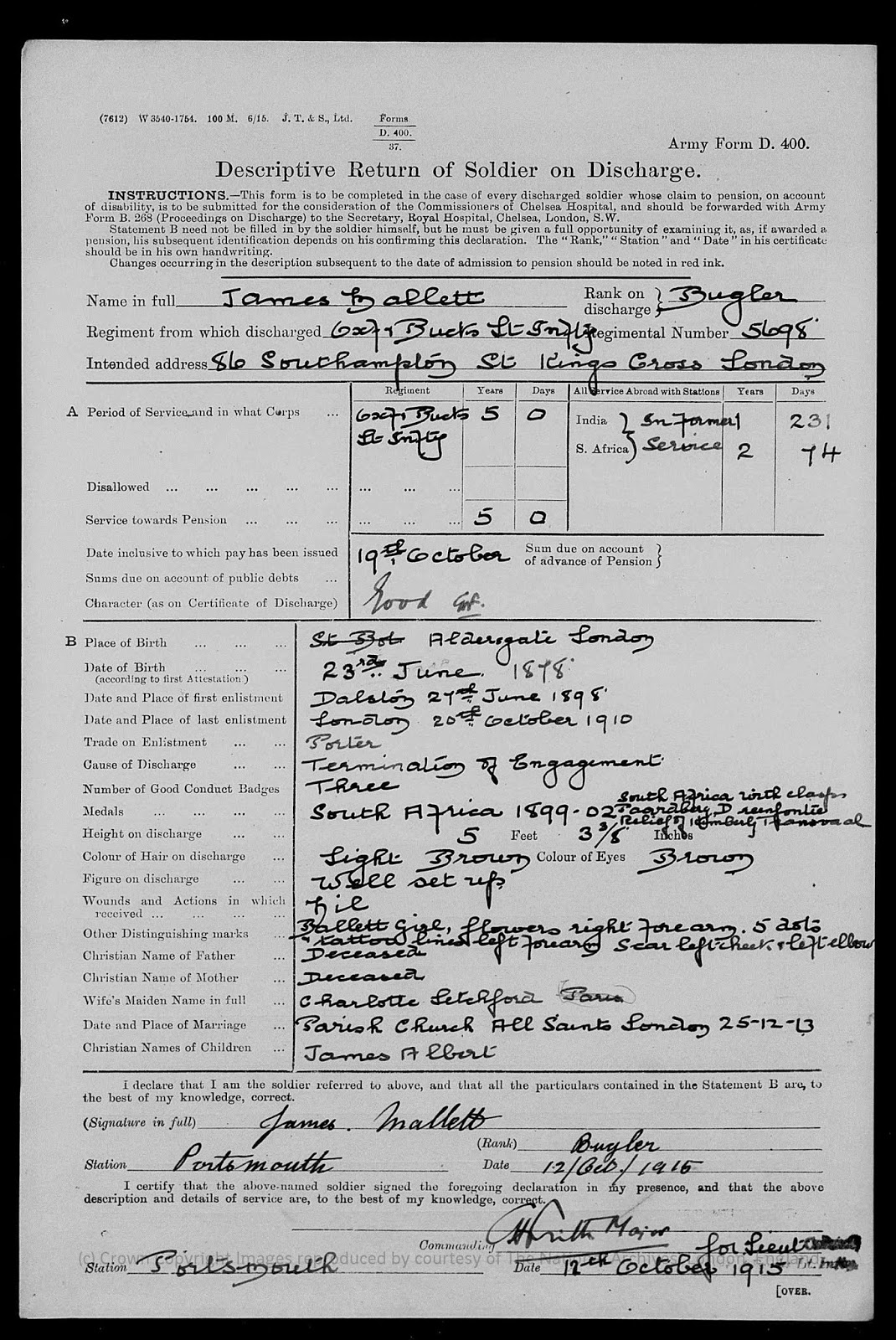
Army Form D.400 - Description on discharge

 
Army Form D.400 is a useful document in giving a picture of a soldier at the end of his service and is packed with information not only about the man's military career but also about his family. On this June 1915 version is space to record details of the soldier's parents, wife and children, not to mention his intended place of residence.
 
The man mentioned in this particular document, a recent research project, originally attested in 1898, extended to complete 12 years with the colours and then enlisted for four years for Section D, Army Reserve. He was three months short of the expiry of that term of service when Britain went to war and he was obliged to complete the four years plus an additional bounty year (which he served in Britain). Upon discharge he promptly re-enlisted and served with the Army Service Corps in France.
 
 All document images reproduced on this post are Crown Copyright, The National Archives. Service and Pension records can be searched and downloaded from Ancestry and Findmypast. Both companies offer FREE 14-day trials.

Saturday, 11 October 2014

Army Form B.2056 - Transfer to Army Reserve

 
Army Form B.2056 gives a useful summary of a man's colour service prior to his transfer to the Army Reserve. In the case of Private Groves (above), his conduct and character is described as "Indifferent. Addicted to drink".
 
 
Brief service history details are given on the following pages, also a description of the man and his intended place of residence. It's a useful document and in my experience there are not too many that survive in WO 97. This appears to have been one form which the MoD decided could be weeded and disposed of, probably because the majority of the information included here is also noted on the attestation papers.
 
Pages 3 and 4 are reproduced below. All document images reproduced on this post are Crown Copyright, The National Archives. Service and Pension records can be searched and downloaded from Ancestry and Findmypast. Both companies offer FREE 14-day trials.


Sunday, 21 September 2014

Army Form B.103 - Casualty Form - Active service


Army Form B.103 is an extremely useful document as it gives not only attestation and enlistment details but also movements from the time the soldier stepped ashore in war zone. These documents can run to several pages and are useful additions to - or substitutes for - attestation papers.

There are two date columns on this form and it's the date on the right which is the date of the event.  So in the example above, Private Anderson was admitted to the 31st General Hospital at Port Said on the 12th December 1916.

All document images reproduced on this post are Crown Copyright, The National Archives. Service and Pension records can be searched and downloaded from Ancestry and Findmypast. Both companies offer FREE 14-day trials.

I research soldiers!
Contact me if you need help.

Sunday, 7 September 2014

Army Form W.5080 - names and addresses of living relatives of a deceased soldier


This is a poignant, sad and touching document. It is also extremely useful to today's family historians as it can give a complete family picture of parents and siblings of the dead soldier in question. Most of the forms that I have seen tend to date to 1919 and there was certainly a large print run delivered that year; see the 2/19 below:


For many family historians, this document and a few others like it (for instance medal acknowledgement slips) are as close as we get to being able to pinpoint our ancestors close to a decade after the 1911 census was taken.

The main document on this post is from my great uncle' surviving service record in WO 363. Rfm John Frederick Nixon was killed in action on 3rd October 1918 and this form lists his parents, four brothers and seven sisters and all their addresses. It's gold-dust for the family historian - but I wish it hadn't been necessary to complete this for him.

All document images reproduced on this post are Crown Copyright, The National Archives. Service and Pension records can be searched and downloaded from Ancestry and Findmypast. Both companies offer FREE 14-day trials.